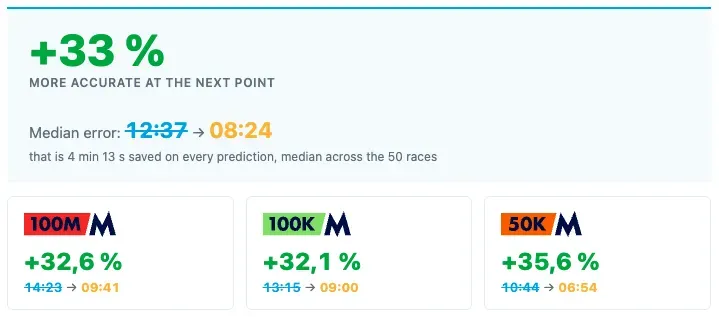
What the model does
Each time a runner passes a checkpoint, Janus instantly recalculates their estimated arrival time for all remaining points on the course, right up to the finish line. The prediction is personalized: it combines the runner's profile (performance index, age, gender, consistency), the pace observed over recent sections, and the technicity of the terrain ahead.
The prediction is refined throughout the race: the further the runner progresses, the more the model learns about their form on the day, and the more accurate the estimation become. This includes nighttime, when the inevitable slowdown is explicitly factored in.
The principle: effort-adjusted speed
Comparing speeds in the mountains only makes sense if the difficulty of the terrain is taken into account. The model therefore operates using "effort distance": each section of the course is converted into an equivalent flat-ground distance. On this common scale, a runner's speed becomes comparable across different sections, whether the terrain is fast and runnable or extremely steep.
The model predicts this effort-adjusted speed for the upcoming section; the estimated time is then calculated by dividing the section's effort distance by the predicted speed. By stringing together the remaining sections, the model determines the estimated arrival time for every point on the course.
Accounting for terrain and gradient
The conversion to effort distance weights every meter covered based on two characteristics: terrain technicity and gradient. These weightings were not set manually; they were statistically estimated using historical race data based on actual observed times.